

Who treats you, and how
- Who
- Dr Manisha Gupta, Principal Dentist, examines you first, plans your care and arranges for an oral surgeon (a dentist with a postgraduate degree, MDS, in surgery of the mouth and jaws) to place the implant at the clinic. You meet the dentist who will treat you at your assessment.
- How
- An assessment first, usually with X-rays, moulds and photographs, then planning.
- If the examination shows you need a CBCT scan (a three-dimensional dental X-ray), we arrange it at a dedicated radiology centre nearby.
- The implant is placed and left to heal before the replacement tooth is fitted.
- Follow-ups from time to time.
- Instruments cleaned, packed and sterilised in our own sterilisation room.
- Visits
- Two stages, at least 3 months apart.
- Time
- 60–90 minutes.
- Anaesthetic
- Local anaesthesia.
- Recovery
- A period of healing after the implant is placed, before the new tooth is fitted.
Implants explained
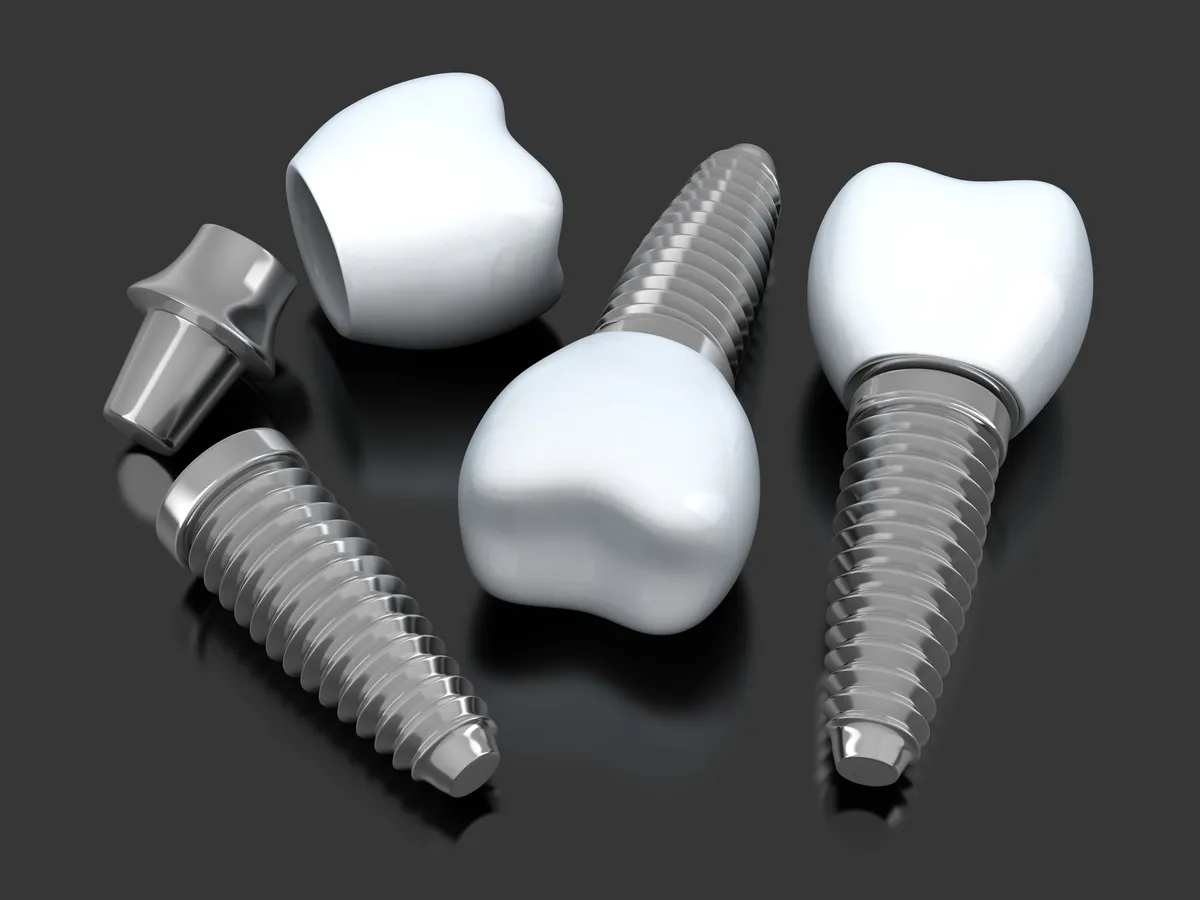
An implant is an artificial root used in dentistry to support a natural looking replacement tooth. The root is made of titanium, which is a very strong biocompatible metal and is placed in the jaw bone, where it joins with the bone, forming a secure foundation. The replacement tooth is made of porcelain and is fitted on top of the titanium root. Usually the tooth and root are known as the implant although the titanium roots can also be used as an anchor for a bar or magnet, to secure a removable denture.
When would I need an implant?
Implants are used to replace a missing tooth, or to replace a tooth that needs extraction. Missing teeth can be replaced with a bridge, a removable partial denture or implants. Implants do not rely on neighbouring teeth for support. Most implants are still in place ten years or more later, about 95 in 100, although some need extra care for the gum around them. Your dentist will explain which option suits you.
What are the alternatives?
The normal methods of replacing missing teeth are bridges or dentures.
A bridge fixes a false tooth to the teeth beside the gap. Bridges can only be provided when there are sufficient strong and healthy remaining teeth. They are a fixed replacement.
Dentures are teeth attached to a removable plastic or metal plate. They have to be taken out every day for cleaning.
Bridges and dentures can work well. For people with no lower teeth, a lower denture held in place by two implants is usually more stable and comfortable than an ordinary denture, and international expert groups recommend it as the first choice where it is suitable. After a tooth is lost, the jawbone in that area slowly shrinks. Studies show that the bone around implants shrinks less than the bone under an ordinary denture.
What does an implant involve?
The procedure for placing implants is:
-
An initial assessment (usually involving X-rays).
-
Placement of the titanium root in the jaw, followed by a time period for healing and integration.
-
A minor procedure to uncover the implant.
-
Making an impression of the new root and its relationship to the other teeth in the mouth.
-
Fitting the replacement tooth onto the root.
Will I need follow-ups?
Yes. Even a successful implant needs check-ups from time to time.
What is the next step?
Arrange a consultation with us to assess your mouth. We will make some moulds and take X-rays and photographs, then plan your treatment with you.
Sources: where the information on this page comes from (5 sources).