

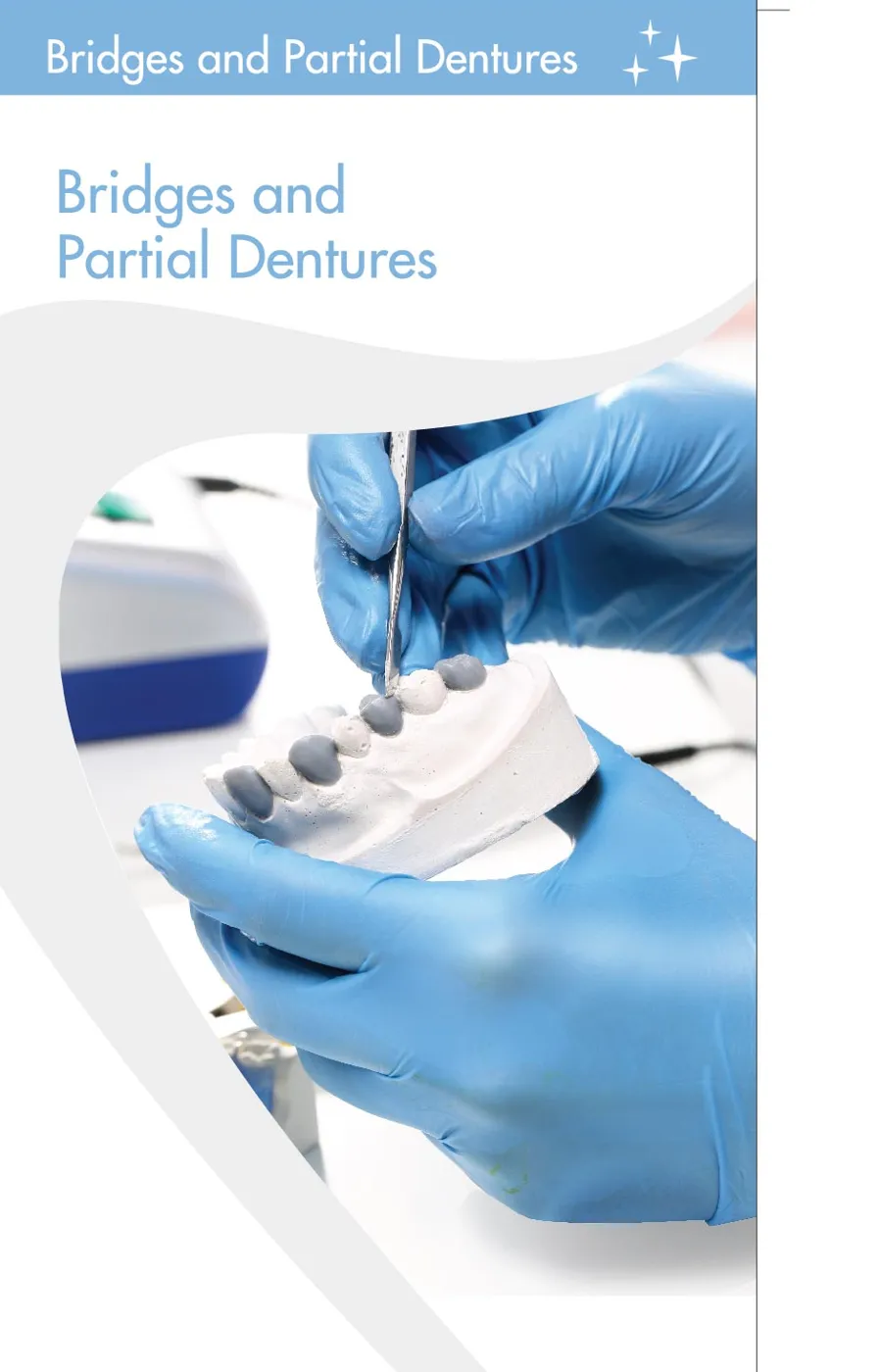
Why replace a tooth which is missing or needs extracting?
One reason is the way you look.
It is also important to replace a missing tooth to balance the way the jaw bites and avoid putting strain on the neighbouring teeth. The teeth next to the space can lean into the gap and alter the way the upper and lower teeth bite together. This can then lead to food getting packed into the gap, which causes both decay and gum disease.
How are missing teeth replaced?
This depends on the number of teeth missing, condition of missing teeth and on where they are in the mouth. There are three main ways to replace the missing teeth.
-
The first is with a removable false tooth or teeth - a partial denture.
-
The second is with a fixed bridge. A bridge is usually used where there are fewer teeth to replace, or when the missing teeth are only on one side of the mouth.
-
And the final option is placement of implants where a titanium rod replaces the root of your tooth.
What is a partial denture?
This is a plate with a number of false teeth on it. It may be all plastic or a mixture of metal and plastic. Both types may have clips (clasps), to help keep the denture in place in the mouth. Metal partial dentures are much stronger. They are lighter to wear and can be supported by the remaining teeth. Although the base is metal, they have gum coloured plastic and natural looking teeth fixed to them.
What is the difference between a plastic partial denture and one that contains metal?
Plastic partial dentures need careful design so that they protect the teeth they fit against.
You can also get flexible plastic dentures.
These dentures do not need clasps as they are held in place by flexing against your natural teeth.
Metal partial dentures are usually made from an alloy of cobalt and chromium and they are much stronger. They are lighter to wear and can be supported by the remaining teeth.
Although the base is metal, they have gum coloured plastic and natural looking teeth fixed to them.
How do I choose the best type for me?
Be guided by your dentist. They will know the condition of your remaining teeth and will be able to advise you on your individual situation.
In most cases a metal-based partial denture gives the best result.
What is the alternative to a partial denture?
A fixed bridge is made by putting crowns on the teeth at either side of the space, and then joining these two crowns together by placing a false tooth in the space.
This is all made in the laboratory and then cemented into place with special adhesives.
The bridge cannot be removed for cleaning.
Another option is an adhesive or ‘Maryland’ bridge. This has wings that are bonded to the back of the supporting teeth with very little drilling involved.
What are bridges made of?
Bridges are usually made of porcelain bonded to precious metal. Sometimes, there are other non-precious metals used in the base for strength. There are also new bridges made entirely of a special type of strong porcelain.
Benefits of a bridge
-
It can improve the way you look, bite, chew and speak.
-
The teeth can be matched to the colour of your own teeth.
-
A bridge can last many years if it is kept clean and there is no accidental damage.
-
Natural teeth are protected from wear and tear and from moving or tilting out of line, which can otherwise cause your teeth to bite together incorrectly.
Can a replacement tooth be fixed to the jawbone?
Yes, by having implants. The success of this technique means you may be able to replace missing teeth without crowning other teeth.
Speak to your dentist at Healthy Roots.